|
|
Autumn salmon fly fishing
(article and photos by Ally Gowans)
 |
| Autumn salmon fishing |
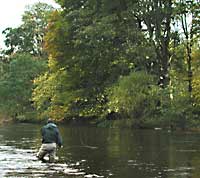
Autumn for the United Kingdom fly-fisherman starts in September
and runs through to the end of November or even December for a few rivers
in the south west of England. It is a time of great change and often it
is the highlight of the salmon angler's season. During summertime low,
warm water is commonplace, even when it rains it takes a lot of precipitation
for the extra water to get past the growing herbage and lift the river
level and so unless conditions are exceptionally wet what spates there
are tend to pass by very quickly. As the days shorten and cool and the
harvest is gathered, nature has no need for vast quantities of water and
so the river's turn comes around. Salmon, sea trout and brown trout know
well that the cool autumn rains will raise the rivers and allow them to
seek out their native pools and spawning riffles. Although salmon and
grilse will enter many of the rivers before autumn, those fish that belong
to small, short rivers or that spawn in the lower reaches of large rivers
have no need to return to freshwater early and expose themselves to all
the attendant risks that low water brings. Instead these fish families
have adapted to returning later in the season, arriving bright, fit and
strong from the salt during the autumn months. It is these fish that are
the legitimate quarry for the late season angler, not the darkly coloured
remnants from earlier runs that are best left to spawn in peace.
More than any other time of year autumn requires the angler to be adaptable.
There are times when low water will require all the craft and delicacy
of a mid summer's morning. Conditions can change quickly however and a
sudden pelt of rain high up on the hills may cause a raging spate within
24 hours. Heavy rain falling on parched ground runs straight off the surface
for a start, until the ground dampens and becomes absorbent. During this
period the water carries all the debris of summer before it and more so
if fields have been ploughed. If there has been a fall of leaves conditions
may be even worse, as you can imagine! Needless to say whilst a spate
is rising and the water is filthy, fishing by any method is hopeless.
Once it begins to fall and clear however, a sudden improvement is likely
and the fish, now in high spirits are keen to move and are also susceptible
to a well-presented fly.
I know it should to be absolutely obvious that a fly has to be seen by
the fish before there is any chance of catching it but its surprising
how often in highly coloured water anglers choose flies that are too inconspicuous.
Sediment that stains the river reduces the amount of light and also, due
to filtration changes the appearance of colours. Generally speaking yellow
and orange are most visible in these conditions. Fluorescent colours I
think are particularly useful. Too often I have witnessed greater success
by anglers using flies incorporating fluorescent yellow or orange and
I am convinced that it makes a substantial difference to your chances.
Concealed by the high, coloured water, fish prefer to take the easy routes
upstream, avoiding powerful flows they travel close to the banks sometimes
in comparatively shallow water. Water between two and four foot deep is
often favoured and smooth glides, pool tails or popply water adjoining
streams offer prime fishing opportunities. Often fish will be found where
you might stand in low water conditions.
A falling spate is always a great opportunity. There are a surprising
number of rivers where water levels between 150 and 450 mm above summer
level produce excellent catches, possibly due to the amount of extra water
that becomes fishable at those levels. Of course as rivers fall the angler
has to adjust his tackle and flies to suit. Fast sinking lines may have
been necessary at the peak of the flood, now slower sinking lines, and
intermediate lines, sink tips and the like play an important roll to present
the fly at the correct depth and speed. Large tube flies might suit high
water conditions but as it drops smaller tubes or dressed flies in slightly
more sombre colours are likely to prove more attractive to the fish. Flies
that combine movement and suitable colours are best. In stained water
Ally's Shrimps, Cascade, Garry Dog, Junction Shrimp and Willie Gunn (with
a gold or silver body) are ideal choices. As a general, sort of basic
rule fly sizes reflect the river volumes. Big flies are commonly recommended
on large rivers such as the Tweed or Tay, whilst on medium to small waters
like the Stincher or South Esk flies as small as 10's or less may be required
as the water fines and clears.
There is a tendency towards more red or orange in autumn fly patterns,
a factor that finds some favour with the fish and a number of theories
why this is thought to be effective. In autumn many of the fish themselves
are heavily coloured. Male salmon become highly patterned with reds and
olives and perhaps the red fly relates to them as a threat of some description.
Perhaps as part of that reason or maybe for entirely different purposes,
salmon's eyesight changes during its stay in fresh water to move its visible
spectrum from blue towards the red and this has the effect of sensitising
their eyesight to red objects. Therefore maybe red flies are just more
obvious to salmon than we judge from our own vision. Whatever the reason,
flies that have a bit of red about them are very successful at the end
of the season. General Practitioner is a typical example.
Another useful colour is white, particularly during those late autumn
days when light is scarce and almost any key target on a fly is helpful.
Hence the popularity of "white wings", that whole family of
successful flies that emanate from the Border rivers. Jungle cock cheeks
are very good because they have natural white fluorescence that shows
up under most conditions and especially so in poor light.
One of the problems of late season fishing is the possibility of landing
fish that are well advanced towards spawning. Male fish with well-developed
kype, red flanks, distended depth and narrow shoulders or females heavy
with spawn. Neither of these fish are fit for consumption, their table
value is low to nonexistent. However fish that have reached that stage
are the most valuable stock for the river and must be carefully handled
and returned so that they survive to spawn.
Autumn is a great time to be on the river, fish are at their most plentiful
and sport can be excellent. Nature's dress is colourful and of course
we have to make the very best of these shortening days because winter
always seems such a long period for the game fisher. I enjoy autumn and
hope that you will also. Tight lines and safe releases.
|
 |